
PSA Regular vs Express: Is Skipping 50 Business Days Worth $69?
PSA's Regular tier now takes 70 to 80 business days, up from 40 to 50 two weeks ago. We ran live grade grids to see when the $149 Express upgrade pays.
Mail a Pokemon card to PSA today on the cheapest tier it still sells, and you should not expect to see it again until December. PSA's Regular service now shows an estimated turnaround of 70 to 80 business days on its own grading page. We read 40 to 50 off that same page on August 10 and quoted it in our post on PSA's upcharge rule. Somewhere in the last two weeks, the wait on the only tier most flippers can afford picked up another thirty business days.
Express did not change. It still costs $149.00 and still shows 20 to 30 business days. So the question that used to be a small one, whether to pay $69.01 more for the faster tier, is now a very different question than it was this time last month.
How PSA's Regular wait got to 80 business days
The slide happened in public, in three steps.
Back on February 10, PSA raised Regular from $74.99 to $79.99 and pushed its estimated turnaround from 20 business days to 25. The company framed the increase as a way to "support more predictable turnaround expectations."
That did not hold. On June 2, PSA paused new submissions to all four Value tiers, which is why Regular is the cheap door today. The reason it gave was volume: a 20% spike in submissions had added 1.6 million cards to a backlog "rapidly approaching 10 million." In the same notice, PSA said Regular would be "temporarily extended to 40 to 50 days," and set a target of getting the backlog down to 5 million units, which it expected to take up to four months.
Twelve weeks into that four months, the Regular wait has gone up rather than down. At 70 to 80 business days it is roughly three times the target PSA set for itself in February. Value services are still paused, with the same banner across the top of the site about extraordinary demand.
PSA grading prices and turnaround times right now
Here is the full board, read off psacard.com this morning, August 24, 2026.
| Service level | Price per card | Max insured value | Estimated turnaround |
|---|---|---|---|
| Regular | $79.99 | $1,500 | 70 to 80 business days |
| Express | $149.00 | $2,500 | 20 to 30 business days |
| Super Express | $349.00 | $5,000 | 10 to 15 business days |
| Walk-Through | $599.00 | $10,000 | 7 to 10 business days |
Business days skip weekends and federal holidays, and the clock starts when PSA logs your submission in, not when you drop it at the counter. Hand PSA a card today on Regular and it lands back on your desk somewhere between December 4 and December 18. Hand it over on Express and you get it back between September 22 and October 6. That is about ten calendar weeks of difference, and ten weeks is a long time to hold a card you cannot sell.
What ten extra weeks in the queue actually costs
We have been measuring this all summer. In July we followed two cards through PSA's queue and found their raw prices basically flat while the PSA 10 prices we were counting on fell 19 and 32%. Last week we widened that to eight cards and found the same thing on six of them: PSA 10 prices were dropping faster than raw prices.
Here is where three of those cards sit today against their July 13 readings, pulled fresh from PriceCharting this morning. Six weeks apart.
| Card | PSA 10 on July 13 | PSA 10 on August 24 | Change |
|---|---|---|---|
| Mega Lucario ex #179 (Mega Evolution) | $435.00 | $387.46 | down 10.9% |
| Dragapult ex #165 (Prismatic Evolutions) | $297.00 | $235.68 | down 20.6% |
| Lillie's Clefairy ex #280 (Ascended Heroes) | $469.74 | $355.50 | down 24.3% |
Dragapult is the one worth pausing on, because in July we singled it out as the card that beat the queue. Its PSA 10 had climbed from $269.64 in June to $297.00 while everything around it sagged, and we said so. It has since given all of that back and then some, and at $235.68 it is now below where we first quoted it. Being right for a month is not the same as being right.
Worth saying plainly: three modern chase cards in a soft stretch is a small sample, and none of them will fall at this rate forever. What the numbers do show is the order of magnitude. Cards like these move 10 to 25% in six weeks fairly routinely, in both directions, and the Regular queue now holds you through two and a half of those windows.
Is PSA Express worth the extra $69?
Express costs $69.01 more than Regular. It pays for itself if your card loses more than $69.01 while it would otherwise have been sitting in line.
That is a flat dollar amount against a percentage move, so the answer comes down almost entirely to what the card is worth graded. We pulled live grade grids on five cards this morning and worked out how far each PSA 10 would have to fall over those extra ten weeks before the upgrade earns its keep.
| Card | PSA 10 (August 24) | Fall needed for Express to pay |
|---|---|---|
| Dragapult ex #165 (Prismatic Evolutions) | $235.68 | 29% |
| Charizard VMAX #74 (Champion's Path) | $313.50 | 22% |
| Lillie's Clefairy ex #280 (Ascended Heroes) | $355.50 | 19% |
| Mega Lucario ex #179 (Mega Evolution) | $387.46 | 18% |
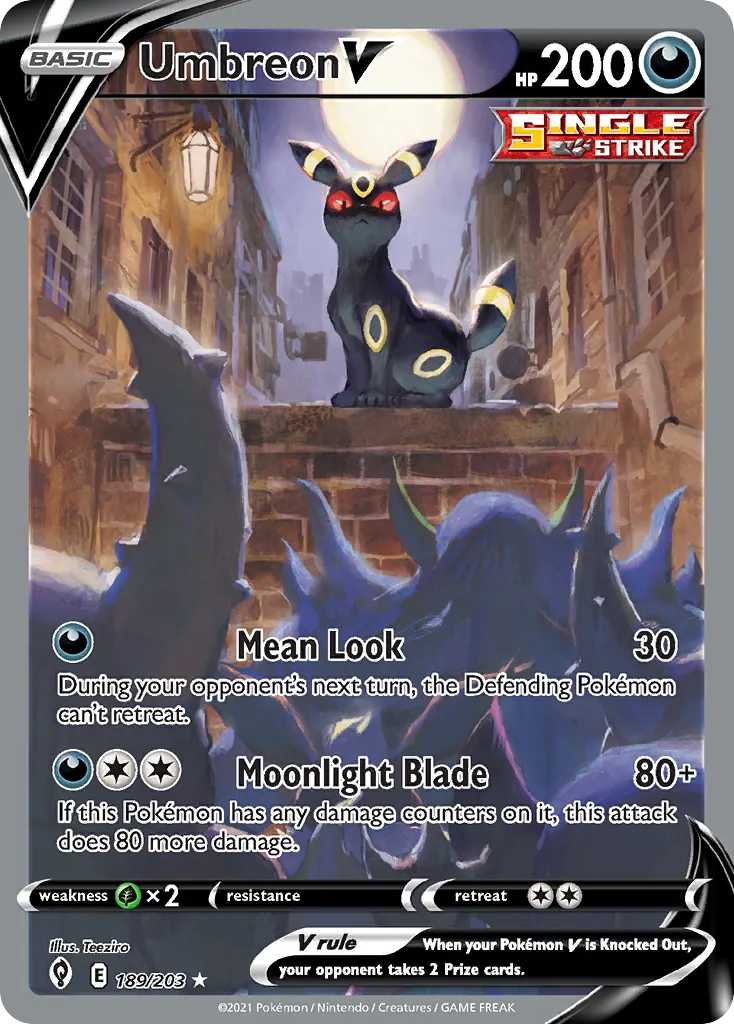
| Umbreon V #189 (Evolving Skies) | $1,043.73 | 7% |
On the Dragapult you need a 29% slide before the faster tier is worth buying, and that is a lot to bet on. On the Umbreon V alt art you need 7%, which a card like that can shed in a quiet month without anything dramatic happening.
So speed is an expensive purchase on a cheap card and a cheap one on an expensive card. Most people do it backwards, paying up for the card they are most excited about rather than the card with the most money parked in the queue. As a rough guide: under about $350 in a PSA 10, take Regular and plan on December. Somewhere north of $700, the $69.01 usually comes back on a modern in-print chase card.
When the tier picks itself
None of the above applies once the card is worth real money, because the tiers carry insured value caps. Regular tops out at $1,500 and Express at $2,500, and those caps are how you declare what the card is worth. Go too low and PSA can move you up a tier and bill you the difference, which is the whole subject of our August 10 piece on the upcharge rule.
Two cards from this morning's pulls show how easy that is to miss. Giratina V #186 from Lost Origin sells for $799.89 raw, comfortably under the Regular cap, but its PSA 10 is $3,336.00, which puts it in Super Express at $349.00. Umbreon VMAX #215 from Evolving Skies is $2,025.00 raw against a $4,249.03 PSA 10, same outcome. On either card, Regular versus Express was never a real decision.
What we would do
Pick the tier off the graded value, not the raw price and not how much you like the card. Under roughly $350 in a PSA 10, Regular is fine and you accept a December return. Between about $700 and $1,500, Express is worth the $69.01 on anything modern and in print. Above $1,500 the cap decides for you.
The date you mailed it is the date the clock on your exit price started, which is why we keep the submission date and fee tier attached to every card in Flipr's submission tracker rather than in a notes app.
There is a bigger question underneath all of this. We ran the buy-the-PSA-10-or-grade-your-own math back when $79.99 was the number to beat, and a lot of cards only just cleared it. At $149.00, or at $79.99 with a return date in December, plenty of those cards stop making sense to send at all. Work out whether the card is worth grading before you work out which tier to grade it on.
Want to flip smarter, not harder?
Flipr's free toolkit surfaces the most profitable cards to grade and the spreads to arbitrage, refreshed every 30 minutes. Twelve tools, zero subscriptions.
Open FliprMore on PSA flipping

PSA's Upcharge Rule Can Add $500 to Your Grading Bill
A PSA upcharge is priced off what your card is worth after grading, not what you paid for it. We ran seven live grade grids to see which cards trip the rule.
Your PSA 10 Loses Value While You Wait for It
We tracked three cards through PSA's grading window. The raw prices barely moved, but the PSA 10 comps we counted on bled 19 to 32% while they sat in line.
Grading a Vintage Pokemon Pack Usually Makes It Worth Less
We read PSA's pack price list and PriceCharting on September 29. On four vintage Pokemon booster packs, most grades sell for less than a raw pack.