
Your PSA 10 Loses Value While You Wait for It
We tracked three cards through PSA's grading window. The raw prices barely moved, but the PSA 10 comps we counted on bled 19 to 32% while they sat in line.
The mailer went out on the last day of May. Two cards inside, both meta darlings, both looking like textbook grade-and-flip plays. We slid them into penny sleeves, then top loaders, then a team bag, taped the whole thing shut, and dropped it at the counter. Easy money on paper. Grade for roughly twenty-five dollars a card, ship the tens for triple the raw price, done.
Then the waiting started. And the market, it turns out, does not wait with you.
The two cards that looked like free money
Here is what the numbers said in late May, straight off PriceCharting the day we made the calls in our weekly roundups.
Lillie's Clefairy ex, the Ascended Heroes secret illustration rare (#280), was sitting at $215.08 raw with a PSA 10 comp of $690. That is a 3.2x jump for a clean slab. Mega Lucario ex from the original Mega Evolution set (#179) was $202.50 raw against a $537.79 PSA 10. Another clean 2.6x.
Both cards were riding tournament attention. Lucario was anchoring the dominant deck. Clefairy was the counter to it. The raw prices were firm, the sold-listing depth was healthy, and every surface-level signal said grade the clean copies and ship the tens. We said as much at the time, with one honest caveat buried in each post: treat these as short meta windows, not long holds.
We were more right about that caveat than we knew.
The queue is a position you did not choose
Nobody talks about the grading window as a market position, but that is exactly what it is. From the moment PSA scans your submission until the slab lands back on your desk, you are long the PSA 10 comp whether you meant to be or not. You cannot sell. You cannot react. You just wait.
And the wait is long. PSA's current turnaround targets run from 25 business days for Regular up through 45 for Value Plus, 75 for Value, and 95 for Value Bulk. A card worth two hundred dollars does not justify the Express tiers, so realistically you are in Value or Value Plus, and those targets are business days, which skip weekends and federal holidays. Ninety-five business days is closer to four and a half calendar months. Even Value Plus at 45 business days is most of a summer. PSA is also clear that these are targets, not guarantees, and they stretch after big product releases. If you want the full breakdown of how the graders stack up on turnaround and fees, we compared PSA, CGC, and BGS head to head earlier this year.
So the real question is not "will this card grade a 10." It is "where will the PSA 10 comp be two to four months from now, when I can actually sell."
The cards came back. The market had moved.
Here is where those same two cards sit today, July 13, pulled fresh from PriceCharting this morning.
| Card | PSA 10 at submission (late May) | PSA 10 today (7/13) | Change | Raw then | Raw today |
|---|---|---|---|---|---|
| Lillie's Clefairy ex #280 | $690.00 | $469.74 | -32% | $215.08 | $198.89 |
| Mega Lucario ex #179 | $537.79 | $435.00 | -19% | $202.50 | $209.79 |
Read that raw column first, because it is the surprising part. Lillie's Clefairy raw barely moved, $215 down to $199. Mega Lucario raw actually went up, $202 to $210. If you had just bought and flipped these raw, you would have broken roughly even and moved on with your capital intact.
Now read the PSA 10 column. The exact number that made grading worth doing, the whole reason to eat the fee and the wait, came off 19% on Lucario and a brutal 32% on Clefairy. The floor held. The ceiling caved. And you were locked in the queue the entire time it happened.
Why the floor holds but the ceiling bleeds
This is not bad luck. It is mechanical, and once you see it you cannot unsee it.
Meta demand supports the raw floor. People still want to play the card, still want it for their binder, so raw buyers keep showing up and the price does not crater. But grading turnaround outlasts the meta window. By the time your slab comes back, the tournament that drove the hype is over, attention has rotated to the next set, and, critically, the PSA population has grown. Every week your card sits in line, more copies of the same card are getting graded and hitting the market alongside yours. More PSA 10s plus cooler attention equals a softer graded comp. The raw stayed liquid; the graded ceiling quietly deflated.
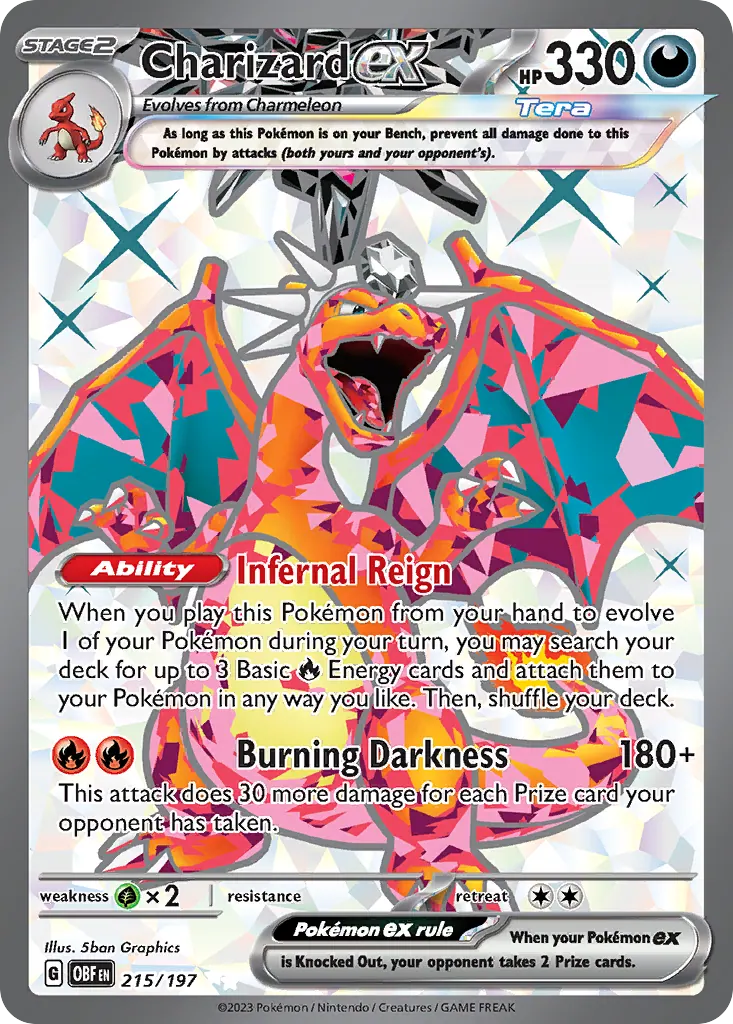
You can watch the same tension on almost any modern chase SIR. The Obsidian Flames Charizard ex Tera art on the cover of this post (#215) is a good one to keep a live tab on: a firm, liquid raw floor sitting under a PSA 10 comp that swings around every time the population report ticks up or a new set steals the spotlight. The pattern is not about which Pokemon it is. It is about the gap between when you commit and when you can sell.
It is a close cousin of the PSA 9 tax we measured across four card tiers: on these modern SIRs the PSA 9 was already a wash against a clean raw, so the entire bet was the 10. When the 10 slides 30%, there is no consolation grade to fall back on. And it rhymes with the broader point that a grade can quietly make a card worth less than raw once you account for era, supply, and fees.
The card that beat the queue
Not every submission gets punished. The exception tells you exactly what to look for.
Dragapult ex, the Prismatic Evolutions secret illustration rare (#165), got a similar hot-card writeup on June 11 at $112.31 raw and a $269.64 PSA 10. A month later it is $117.62 raw, up 4.7%, and the PSA 10 is $297.00, up 10.1%. The graded ceiling did not bleed. It firmed while the card sat.
What made Dragapult different was not that it was a better card. It was that Prismatic Evolutions is an enormous, deeply liquid English print, and Dragapult stayed the deck to beat long after the tournament weekend that first lit it up. Deep liquidity plus durable, ongoing format relevance is the combination that lets a graded comp survive the grading window. The two SIRs that bled were thin meta plays whose relevance had a shelf life shorter than PSA's Value tier.
So the differentiator is not popularity in the moment. Lillie's Clefairy was extremely popular in the moment. The differentiator is whether that demand is still there in four months, and whether the set is liquid enough that a growing PSA population gets absorbed instead of flooding a thin market.
What to do before your next mailer goes out
Three things came out of this, and they cost us a couple hundred dollars of graded value to learn.
First, price the exit off a conservative PSA 10, not today's hot comp. When you do the submission math on a meta card, do not plug in the $690 that is glowing on the screen right now. Haircut it. Assume the graded ceiling will be 15 to 30% lower by the time you can sell, and only submit if the deal still works at that number.
Second, for thin meta-window cards, selling raw into the attention is often the better trade than grading. The raw floor is the durable part. On both cards here, a raw flip would have preserved your capital and your optionality while the grade-and-wait play lost a third of its upside.
Third, only run the patient grade-and-wait on cards with real liquidity and durable relevance, the Dragapult profile, not the flavor-of-the-week profile. And if you are grading a thin hot card anyway because the 10 spread is genuinely huge, consider paying up for a faster tier to shrink the window you are exposed to.
The grading window is dead capital and open market risk at the same time, which is exactly why we keep hammering that you should count profit per day, not profit per card. A card locked in PSA's queue for four months is not earning; it is quietly repricing against you. Flipr's Submission Tracker exists partly for this reason: it logs your cost basis and the date you sent the card, so you can watch the comp move while you wait and decide with your eyes open instead of getting surprised at the mailbox.
The card you submit is not the card you sell. Plan for the gap.
Want to flip smarter, not harder?
Flipr's free toolkit surfaces the most profitable cards to grade and the spreads to arbitrage, refreshed every 30 minutes. Twelve tools, zero subscriptions.
Open FliprMore on PSA flipping

PSA Regular vs Express: Is Skipping 50 Business Days Worth $69?
PSA's Regular tier now takes 70 to 80 business days, up from 40 to 50 two weeks ago. We ran live grade grids to see when the $149 Express upgrade pays.

PSA 10 Pokemon Card Prices Are Dropping Faster Than Raw Cards
We re-checked eight cards we covered since May. Raw prices fell about 14%, PSA 10 prices fell about 19%, and the reward for grading shrank on six of the eight.

Buy the PSA 10 or Grade Your Own? The $79.99 Math
PSA paused its Value tiers, so grading now starts at $79.99. We ran the break-even gem rate on seven live price grids to find when buying the slab wins.