
When a PSA Grade Makes Your Card Worth Less
Live PriceCharting grids show a Grade 8 on a modern card can sell below raw. Here is which grades lose money, which print, and how a card's era decides.

Send a clean raw Dragapult ex worth $123 to PSA, wait two months, pay the fee, and get back a Grade 8. Congratulations: your card is now worth $91. You spent money and time to make it less valuable. That is not a freak outcome or a horror story. It is the default math on most modern cards, and almost nobody warns new flippers about it before they fill out their first submission form.
The popular mental model is that a grade is a strict upgrade. Slab equals more money, full stop. The real market does not work that way. On a modern card the raw price already assumes a near-mint copy, so the grading scale starts underwater and only climbs back above the surface at the very top. On vintage it is the opposite. We pulled live PriceCharting grids today, June 15, 2026, to show exactly where the line sits.
The data: five cards, every grade, pulled today
Each row is the full grade ladder for one card, straight from PriceCharting on June 15, 2026. Read across and watch what the grade actually does to the price.
| Card (era) | Raw | Grade 7 | Grade 8 | Grade 9 | Grade 9.5 | PSA 10 |
|---|---|---|---|---|---|---|
| Dragapult ex #165, Prismatic Evolutions (modern) | $123.05 | $45.01 | $91.00 | $109.95 | $152.15 | $268.54 |
| Pikachu ex #238, Surging Sparks (modern) | $313.07 | $210.00 | $262.82 | $311.29 | $650.00 | $1,066.66 |
| Gengar VMAX #271, Fusion Strike (modern) | $873.37 | $637.71 | $810.00 | $966.13 | $1,475.00 | $2,577.38 |
| Umbreon VMAX #215, Evolving Skies (modern) | $1,997.73 | $1,560.00 | $1,895.43 | $2,247.00 | $2,900.00 | $4,600.00 |
| Charizard #4, Base Set Unlimited (vintage) | $390.71 | $725.00 | $1,187.50 | $3,032.77 | $3,500.00 | $30,100.00 |
The four modern cards and the one vintage card are playing two completely different games. Once you see it, you cannot unsee it.
On modern cards, the ladder starts below the floor
Look at the four modern rows. On every single one, a Grade 7 sells for less than the raw card. On three of the four, a Grade 8 does too, or barely ties. On the Dragapult, even the Grade 9 ($109.95) sells under the raw copy ($123.05). You read that right: a PSA 9 on a current Special Illustration Rare can be worth less than the unslabbed card you started with.
The reason is simple once you say it out loud. A modern card pulled from a pack and sleeved immediately is presumed near mint. The raw market price already bakes in "this is a clean copy." So when PSA stamps a 7 or an 8 on it, the slab is not adding information that helps. It is publishing a defect. It is a certificate that says this copy is below the condition the raw buyer was already assuming, and the price drops to match. The plastic case does not rescue it.
That means on a modern card the entire payoff lives in the PSA 10, and to a lesser degree the 9.5. The Pikachu ex is the cleanest example: raw $313, and the 7, 8, and 9 all hover right around that same $313, doing nothing for you, while the PSA 10 leaps to $1,067. The gap between a 9 and a 10 doing all the work is the exact trap we measured in detail in the PSA 9 tax breakdown. This data extends that lesson one rung lower: it is not just that the 9 underperforms the 10, it is that the 8 and 7 are often outright losses against the raw card you destroyed to make them.
Now layer the fee on top. PSA's cheapest Value tier runs around $33 per card as of early 2026 (with a 20-card minimum and a 60-plus business day wait), and Regular sits near $75 to $80 per card. Rates shift, so confirm current pricing before you submit, but the direction is all that matters here. On the Dragapult, you paid at least $33 to convert a $123 asset into a $91 asset. That is a $65 round trip in the wrong direction, fee included, and you waited two months to lose it. The capital you tied up doing it could have flipped two or three times raw in the same window, which is the whole argument behind counting profit per day instead of profit per card.
Vintage flips the entire thing
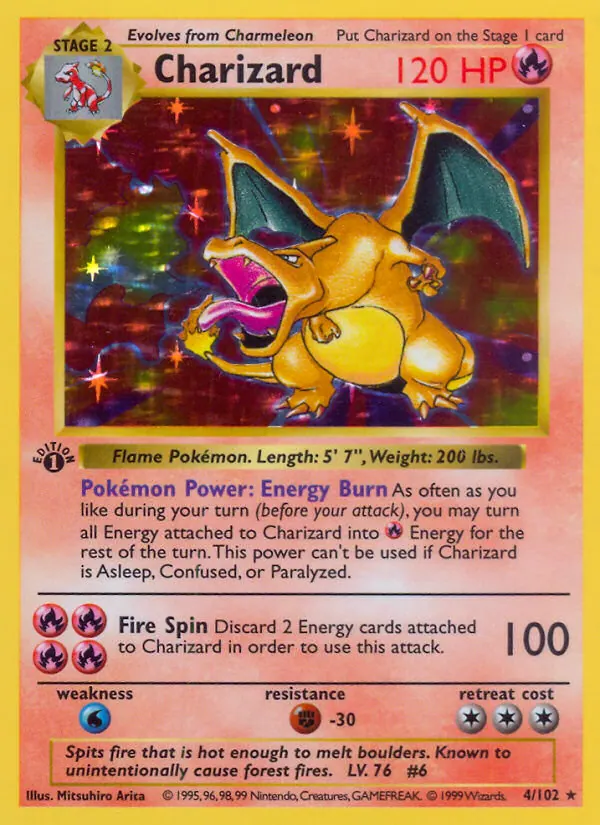
Now read the Base Set Charizard row again, because it breaks every rule the modern cards just set. Raw $390.71. Grade 7 is already $725, nearly double the raw price. Grade 8 is $1,187, roughly 3x. The 9 is over $3,000, and the PSA 10 is a different planet at $30,100. On this card there is no grade that loses you money against raw. Every rung up the ladder prints.
Why the inversion? Because a raw 1999 Base Set Charizard is, by default, a beat-up card. It has been shuffled, traded, binder-flexed, and thumbed for 25-plus years. The raw market assumes damage. So when PSA certifies that a specific copy survived as a genuine 7, that is good news the raw price did not assume, and the slab adds real value. A PSA 8 is borderline miraculous for a card that age, and the price reflects scarcity, not just condition. The grade is supplying information that makes the card worth more, which is the exact opposite of what it does to a card printed last year.
This is the rule hiding under the table: grading pays when the slab tells the buyer something they did not already assume. On vintage, "this old card is actually clean" is valuable news. On modern, "this brand-new card is actually a little dinged" is bad news, and the market charges you for delivering it.
What to do before you submit
The practical move is to figure out which game your card is in before you pay a cent. A few honest checks:
- If it is modern, you are making an all-or-nothing bet on the PSA 10. Treat the 9, 8, and 7 as outcomes that range from break-even to a real loss. So the only question that matters is your gem-rate read on that specific copy. Run the four physical checks first, the ones in how to tell if a card will PSA 10, and if centering or edges are anything short of clean, the expected value is usually negative. Do not send a likely 8 to chase a 10. The Flipr Profit Calculator will run the raw-vs-graded spread against your hit rate so you can see the break-even before you commit the fee, not after.
- If it is vintage, the calculus loosens a lot. When even a 7 clears raw by a comfortable margin, submitting is far more forgiving of an imperfect copy, because there is no grade that puts you underwater. The downside is capped and the upside is enormous. The bet shifts from "will it 10" to simply "is it authentic and stable."
- Either way, check the population first. A growing pop on a modern card compresses the PSA 10 premium faster than people expect, which is exactly the kind of signal the PSA pop report surfaces before the price guide catches up.
The takeaway
A grade is not a free upgrade. It is a public statement about a card's condition, and whether that statement adds or subtracts value depends entirely on what the raw market was already assuming. On modern cards the market assumes near mint, so anything below a 10 ranges from useless to a loss, and the fee makes a low grade a guaranteed mistake. On vintage the market assumes wear, so every grade up the ladder is found money. Before you fill out a submission, decide which of those two games you are actually playing. The cards in the same hobby, in the same binder, are not on the same scale.
Want to flip smarter, not harder?
Flipr's free toolkit surfaces the most profitable cards to grade and the spreads to arbitrage, refreshed every 30 minutes. Twelve tools, zero subscriptions.
Open FliprMore on PSA flipping
The PSA 9 Tax: What Missing a 10 Really Costs
We pulled live PSA 9 and PSA 10 prices across four card tiers. The gap swings from under 2x to over 13x, and modern chase cards hide a brutal PSA 9 trap.
Most PSA 9 Pokemon Cards Are Not Worth Cracking
Live PriceCharting grids and PSA's own fee page show what cracking a PSA 9 and resubmitting costs in 2026. The $1,500 insured value cap is the catch.
PSA 10 Pokemon Card Prices Are Dropping Faster Than Raw Cards
We re-checked eight cards we covered since May. Raw prices fell about 14%, PSA 10 prices fell about 19%, and the reward for grading shrank on six of the eight.