
Japanese vs English Pokemon Cards: The Grading Math
Japanese cards grade higher. That does not make them the better flip. We pulled four live grade ladders in both languages and ran the actual profit math.
There is a piece of advice that gets repeated in every Pokemon flipping thread, and it is almost always delivered as settled fact: grade Japanese, not English. The reasoning sounds airtight. Japanese print runs hold tighter centering tolerances, the cards come off the press cleaner, and the gem rate is meaningfully higher. If you are paying a flat fee per card for a shot at a PSA 10, you want the version that hits 10 more often. Case closed.
Except that argument only covers one of the three numbers that decide whether a submission makes money. It tells you about the probability. It says nothing about what you pay to get in, and nothing about what the market pays you on the way out. On real cards, those two numbers move in the opposite direction often enough that the "just grade Japanese" rule sends people into some of the worst trades available to them.
So we pulled the full grade ladders for four cards that exist in both languages, straight off PriceCharting on July 27, 2026, and ran the arithmetic.
Four cards, two languages, live ladders
These are matched pairs: same Pokemon, same artwork family, same year, one English printing and one Japanese printing.
| Card | English raw | English PSA 10 | Japanese raw | Japanese PSA 10 |
|---|---|---|---|---|
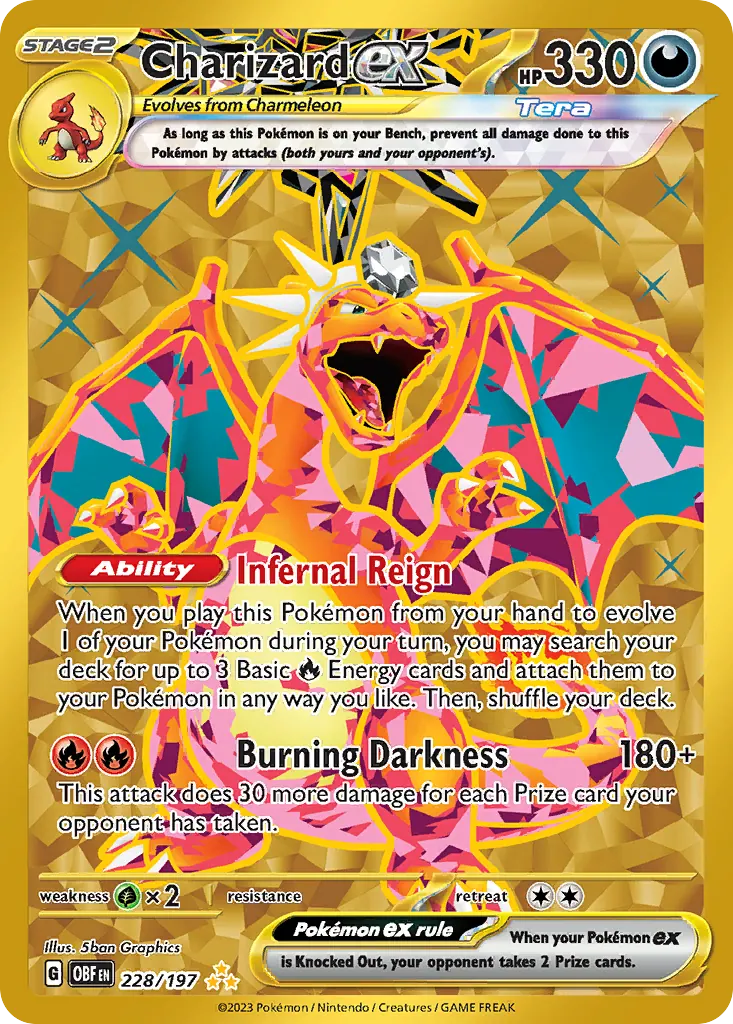
| Charizard ex SIR (Obsidian Flames 223 / Ruler of the Black Flame 134) | $115.90 | $790.00 | $160.38 | $467.69 |
| Lugia V alt (Silver Tempest 186 / Paradigm Trigger 110) | $481.00 | $1,400.25 | $565.37 | $1,220.00 |
| Umbreon VMAX alt (Evolving Skies 215 / Eevee Heroes 095) | $2,224.50 | $4,557.11 | $2,000.00 | $4,850.95 |
| Rayquaza VMAX alt (Evolving Skies 218 / Blue Sky Stream 083) | $1,033.58 | $2,851.30 | $2,241.00 | $6,762.50 |
Look at the split. On two of the four, the English card has the wider gap between raw and PSA 10. On the other two, the Japanese card does. There is no language-level rule here at all. Whatever is true of this hobby, "Japanese is the better grading play" is not a fact about Japanese cards. It is a fact about specific cards, and it flips.
The Charizard ex line is the one that should stop you. The Japanese copy costs 38% more to buy raw and its PSA 10 sells for 41% less. You are paying a premium to enter a trade with a smaller exit. The higher gem rate has to work very hard to dig out of that hole, and as it turns out, it cannot.
Where English wins by three times
Run the Charizard ex both ways. Both cards sit comfortably under $1,500 in value, so both go in at PSA's Regular tier, currently $79.99 per card. Assume you sell the slab on eBay at roughly a 13.25% final value fee and budget about $10 per card for shipping and insurance in both directions.
English, on a gem: $790.00 sale, $104.68 to eBay, leaving $685.32. Subtract the $115.90 you paid raw, the $79.99 grading fee, and $10 in shipping. You clear about $479 on the card.
Japanese, on a gem: $467.69 sale, $61.97 to eBay, leaving $405.72. Subtract $160.38 raw, $79.99 grading, $10 shipping. You clear about $155.
Same Pokemon. Same art. Same submission. The English copy pays three times as much for the identical outcome.
Now the part that actually settles the argument. Both cards have a downside, because a PSA 9 on a modern card is frequently a loss, and this is no exception. The English 9 reads $140.00 and the Japanese 9 reads $176.46, and after fees both of those come back roughly $84 and $97 underwater respectively. Which means you can solve for the gem rate each version needs just to break even:
- English Charizard ex: about 15%
- Japanese Charizard ex: about 39%
That is the whole ballgame. Give Japanese the most generous gem-rate advantage anyone claims for it, say 70% against 45% for English, and the English submission still returns roughly $169 in expected value against the Japanese card's $80. The Japanese card grades better and loses anyway, because its break-even bar sits two and a half times higher.
Where Japanese wins by nearly as much
Then there is Rayquaza VMAX, which inverts every part of that.
The Japanese Blue Sky Stream copy costs more than twice the English raw ($2,241.00 against $1,033.58), but its PSA 10 sells for $6,762.50 against $2,851.30. That gap is so wide it survives a much uglier fee structure. Both cards blow past Regular's $1,500 ceiling, so the English submission goes in at Super Express ($349, max declared value $5,000), and the Japanese card's ceiling is high enough that it clears even that and lands at Walk-Through ($599).
Net on a gem after eBay's cut and shipping: roughly $1,076 English, $3,011 Japanese. Break-even gem rates run about 22.5% for the English copy and 12.4% for the Japanese one. The Japanese card here needs a lower hit rate to pay off, and it also has the better hit rate. Both advantages point the same way. Grade the Japanese one and it is not close.
The rule that actually holds
The variable nobody in these threads names is which language the collector base for that specific card prefers.
English Charizard is a global blue chip with a deep Western buyer pool, and that pool pays up for slabs. Japanese Rayquaza alt arts and the Eevee Heroes chase cards have their own dedicated, well-capitalized following that treats the Japanese printing as the definitive one. The gem rate is a property of the printing press. The exit price is a property of who wants the card, and those two things are unrelated.
Which gives you a working rule that is more useful than "grade Japanese":
- Pull both grade ladders before you buy anything. Not the raw prices, the full ladder including PSA 9 and PSA 10.
- Compute the spread (PSA 10 minus raw) for each language, then subtract the grading tier and about 13% for selling fees.
- Solve for the break-even gem rate on each. Whichever version needs the lower rate is your submission, and the gem-rate difference between languages only matters if the two are close.
- If the ladder does not exist for the Japanese version because nobody grades it, that is your answer. Thin graded comps mean a slow sale at a discount, whatever the pop report says.
Flipr's profit calculator does steps two and three for you, but the arithmetic is simple enough to run on a phone in a card shop, and the discipline matters more than the tool.
The fee change that moved the goalposts
One more thing that has quietly reshaped all of this since June. PSA is currently pausing its Value services. As of today, the cheapest way to get a card graded is Regular at $79.99 per card with a 40 to 50 business day turnaround, up from the $24.99 to $32.99 range the Value tiers used to offer.
A flat fee is regressive. When the floor was $25, a card with a $200 PSA 10 was a defensible submission. At $79.99 it usually is not. This punishes the Japanese side of many matched pairs specifically, because Japanese chase cards more often land in that lower-value band where a fixed fee eats the whole margin. It is the same trap as a fat PSA 10 multiplier on a cheap card: the ratio looks great and the dollars do not clear the fee.
The 40 to 50 business day window is its own tax, and we have watched graded comps bleed while cards sit in that queue. Price your exit off where the comp is likely to be in three months, not where it is today, and know which marketplace actually nets you the most before the slab comes back.
The takeaway
Stop treating language as the decision. It is one input into a three-number problem, and it is the input you have the least control over. Pull both ladders, subtract the fees, and solve for the break-even gem rate. On Charizard ex that math says English by three times. On Rayquaza VMAX it says Japanese by nearly the same margin. Anyone telling you one language wins across the board has not checked a ladder recently.
Want to flip smarter, not harder?
Flipr's free toolkit surfaces the most profitable cards to grade and the spreads to arbitrage, refreshed every 30 minutes. Twelve tools, zero subscriptions.
Open FliprMore on PSA flipping
PSA 10 Pokemon Card Prices Are Dropping Faster Than Raw Cards
We re-checked eight cards we covered since May. Raw prices fell about 14%, PSA 10 prices fell about 19%, and the reward for grading shrank on six of the eight.
Buy the PSA 10 or Grade Your Own? The $79.99 Math
PSA paused its Value tiers, so grading now starts at $79.99. We ran the break-even gem rate on seven live price grids to find when buying the slab wins.
Why a Huge PSA 10 Multiplier Is Usually a Trap
An $18 card with a $900 PSA 10 looks like free money. We pulled the full grade ladders. The size of that multiple is a warning about your odds, not an invitation.