
Why a Huge PSA 10 Multiplier Is Usually a Trap
An $18 card with a $900 PSA 10 looks like free money. We pulled the full grade ladders. The size of that multiple is a warning about your odds, not an invitation.
Pull up a Greninja BREAK. As of today, July 23, 2026, PriceCharting has the raw copy at $17.99 and the PSA 10 at $900. That is a fifty-times multiple sitting right there on the screen. Every instinct a flipper has says the same thing: buy the eighteen-dollar card, send it in, collect nine hundred. Print money.
Here is the take, and we will defend it with the actual grade ladders below: a giant raw-to-PSA-10 multiple is not a measure of opportunity. It is a measure of how rarely a copy survives to gem. The number that looks like the reason to grade is actually the market telling you your odds of pulling it off are small. The bigger the multiple, the louder the warning.
The number everyone reads backwards
A PSA 10 price is set by supply and demand like anything else. When a PSA 10 trades at fifty times the raw, that is not the market being generous. It is the market pricing in scarcity, and the scarce thing is a gem copy. If half of all submissions came back a 10, the PSA 10 would not be worth fifty times raw, because there would be a flood of them. It is worth that much precisely because almost nobody can produce one.
So the multiple is really an inverted gem rate. A 2x multiple says gems are common. A 50x multiple says gems are rare. Reading a fat multiple as upside is reading the number backwards. It is upside conditional on an outcome the number itself is telling you is unlikely. This is the same logic behind the price gap between a PSA 9 and a PSA 10: the gap is wide because the wall between the two grades is high.
What a BREAK card actually costs you to grade
BREAK cards are the cleanest example of this trap on the modern board. They are the horizontal gold-bordered cards from the 2016 XY sets, full-surface foil, and they are notorious for coming back below a 10. The textured foil shows every print line, the gold border shows every speck of whitening, and centering on that era was rough. Here is what the full ladder looks like on two of them, pulled today.
| Card | Ungraded | PSA 9 | PSA 10 | PSA 10 / raw |
|---|---|---|---|---|
| Greninja BREAK (BREAKpoint #41) | $17.99 | $93.89 | $900.00 | 50x |
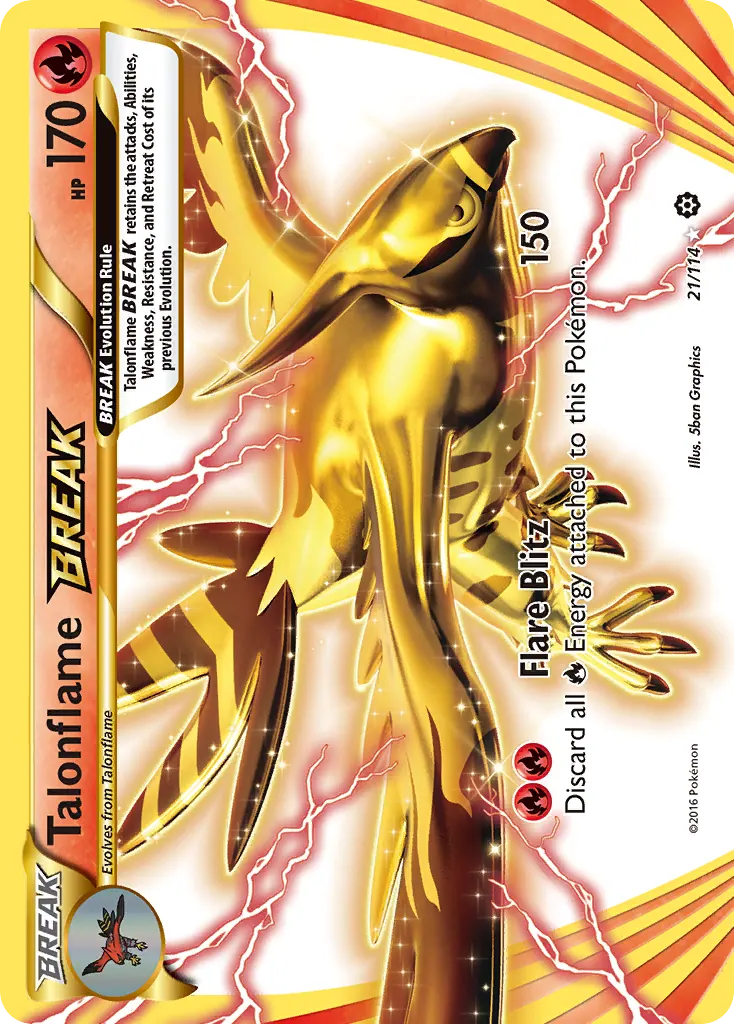
| Talonflame BREAK (Steam Siege #21) | $5.00 | $20.94 | $115.47 | 23x |
Now run the real math on a non-gem outcome, because that is the outcome you should expect. Grading costs roughly $20 to $25 a card once you count PSA's fee and shipping both ways. Selling costs another 13% or so in marketplace and payment fees.
Take the Talonflame. If it grades a 9, you sell it for $20.94, net about $18 after fees, then subtract the $22 you spent grading and the $5 raw. That is a loss. An 8 is a worse loss. Only the 10 at $115 pays you anything, and it pays you a lot. So the entire trade is a bet on one outcome, and the 23x multiple is the tell that the outcome is thin.
The Greninja is milder because its 9 is a real card at $93.89, so a 9 still nets you around $40 of profit. But look at the shape: the 10 is nearly ten times the 9. You are not grading for the $94 result. You are grading for the $900 result, and the market has already told you how many copies get there. Everything below the 9 is a cliff, and if your card is not razor sharp it falls off it. That is why our old advice on this exact card was to treat it as a raw flip unless the copy is genuinely pristine. The "unless pristine" was doing all the work in that sentence.
The vintage version of the same trap
Dark-holo vintage plays the trap a little differently. Here is the original Darkrai Lv.X from 2008's Great Encounters, pulled today: raw $51.60, PSA 10 $9,142.64. That is a 177x multiple, and we flagged this card as a grade-and-find-out lottery ticket last week.
The difference is that the whole ladder is rich. A 7 is $100, an 8 is $350, a 9 is $999. Even a mediocre grade doubles your raw here, because any slab of a 2008 mirror-holo Lv.X is scarce. So the downside is protected in a way the BREAK cards' downside is not. But the 177x headline is still not your expected outcome. It is a survivorship premium. Mirror-holo Lv.X surfaces scratch if you look at them wrong, and the number is screaming that a true gem almost never happens. You will very likely land a 7 or an 8, bank a solid result, and never touch the nine grand. Reading the pop report first, the way we walked through here, tells you the same story the multiple does: the top of the ladder is nearly empty.
What a healthy multiple looks like
For contrast, here is a card that is actually built to grade for profit. Dragapult ex, the Prismatic Evolutions special illustration rare, pulled today: raw $102.43, PSA 10 $279.53. A 2.7x multiple.
That looks boring next to a 50x, and boring is the point. The whole ladder clusters near the raw price, which is what a high gem rate looks like: a modern white-bordered card where whitening hides, centering is better, and a large share of clean copies actually hit the 10. Nobody is priced out of the top grade because plenty of people reach it. You are not betting on a thin tail. You are grading a card that reliably grades. A 2x to 4x multiple on a liquid modern chase is a tradable grade. A 50x multiple on a textured BREAK card is a raffle.
We got the timing half-wrong, and here is the tell
Back on June 4 we called Greninja BREAK a raw flip riding Mega Greninja nostalgia, and we warned the pump would fade and the roughly $22 base would reassert. That timing call was wrong, and the ledger says so plainly. Seven weeks later the TCGPlayer market is $31.08, up from the $27.73 we flagged, and the PriceCharting raw firmed to $17.99 from $14.38. It did not fade. The PSA 10 ceiling actually climbed from $736 to $900.
The lesson we banked is the one this whole post is built on. On a genuinely low-population card riding a durable catalyst, the fat multiple is not a blip that mean-reverts. It is structural, because the thing creating it, a tiny supply of gem copies, does not change when the hype cools. We were right that most people should not grade this card. We were wrong to expect the number to shrink. If anything it widened, which is exactly what a real scarcity signal does.
How we actually size it now
The rule we run, and the one baked into how Flipr's profit calculator frames the raw-to-slab gap, is to price the trade off the grade you will realistically get, never the grade on the headline. Before you submit a fat-multiple card, do the honest pre-grade: centering, gold-border whitening, surface scratches on the foil, the full checklist we use here. If you cannot look at the copy and confidently call it a gem, assume you will land a grade below the top and do the loss math on that outcome first. On most BREAK cards that math is a loss, which means the correct move is to sell it raw and let someone else buy the raffle ticket.
The takeaway is short. A big PSA 10 multiplier is not a green light. It is the market quoting you the odds, and the odds are bad. The cards worth grading for steady money are the ones with the unglamorous 2x and 3x ladders, because a modest multiple is what a high gem rate looks like. When the multiple gets huge, the profit did not get bigger. Your chance of touching it got smaller.
Want to flip smarter, not harder?
Flipr's free toolkit surfaces the most profitable cards to grade and the spreads to arbitrage, refreshed every 30 minutes. Twelve tools, zero subscriptions.
Open FliprMore on PSA flipping
PSA 10 Pokemon Card Prices Are Dropping Faster Than Raw Cards
We re-checked eight cards we covered since May. Raw prices fell about 14%, PSA 10 prices fell about 19%, and the reward for grading shrank on six of the eight.
Buy the PSA 10 or Grade Your Own? The $79.99 Math
PSA paused its Value tiers, so grading now starts at $79.99. We ran the break-even gem rate on seven live price grids to find when buying the slab wins.
Japanese vs English Pokemon Cards: The Grading Math
Japanese cards grade higher. That does not make them the better flip. We pulled four live grade ladders in both languages and ran the actual profit math.