
Buy the PSA 10 or Grade Your Own? The $79.99 Math
PSA paused its Value tiers, so grading now starts at $79.99. We ran the break-even gem rate on seven live price grids to find when buying the slab wins.
Go to psacard.com right now and the first thing on the page is a banner: "Due to extraordinary demand, PSA is temporarily pausing Value services." Scroll down to pricing and the cheapest option left is Regular at $79.99 per card, max insured value $1,500, 40 to 50 business days. Express is $149.00, Super Express is $349.00, Walk-Through is $599.00. That was all live as of today, August 3, 2026.
The Value tiers used to run $24.99 to $32.99, and they went away on June 2. So the floor on a submission tripled two months ago, and a lot of people are still doing their grading math on the old number. On one card we track, N's Zoroark ex from Journey Together, that fee change moved the break-even gem rate from 47% to 99%. A card that was a reasonable submission at the old fee is now, mathematically, not a submission at all.
TwicebakedJake covered the announcement itself when it landed, and it is a clear walkthrough of exactly which tiers got pulled:
The question most people ask backwards
The usual framing is "should I grade this card?" That question has no clean answer because it compares grading against doing nothing.
The better question, if what you actually want is to own a PSA 10 of something, is: is it cheaper to buy the slab or to make the slab? Both paths end with the same object in your hands. One of them costs less. That is a comparison with a real answer.
Framing it this way also cancels out a variable that muddies most grading math. If you plan to sell the 10 eventually, both paths pay the same marketplace cut on the same sale price, so the seller fee drops out of the comparison entirely. You are left comparing two acquisition costs.
The formula
Buying is simple: you pay the PSA 10 market price.
Making one is a repeated bet. You buy a clean near-mint copy at price R, pay the all-in grading cost F, and with probability g you get your 10. The rest of the time you get something else, overwhelmingly a 9, which you can liquidate at its market price S minus the marketplace cut.
Set the expected cost of making a 10 equal to the price of buying one, solve for g, and you get the break-even gem rate:
g* = (R + F - S') / (P - S')
where S' is the PSA 9 price net of a 13% selling fee and P is the PSA 10 price. If your honest gem rate on that card beats g*, make the slab. If it does not, buy the slab.
Seven live grids, one number each
Every price below came off PriceCharting on August 3, 2026, with near-mint raw costs cross-checked against TCGPlayer market prices from the Pokemon TCG API the same day. All-in grading cost is $95 (Regular at $79.99 plus about $15 round-trip shipping and insurance), except Umbreon VMAX, whose declared value pushes it onto Express at $164 all-in.
| Card (set, number) | Raw NM | PSA 9 | PSA 10 | Break-even gem rate |
|---|---|---|---|---|
| N's Zoroark ex (Journey Together #185) | $50.52 | $48.00 | $146.62 | 99.0% |
| Darkrai VSTAR (Crown Zenith #GG50) | $101.72 | $110.00 | $300.95 | 49.2% |
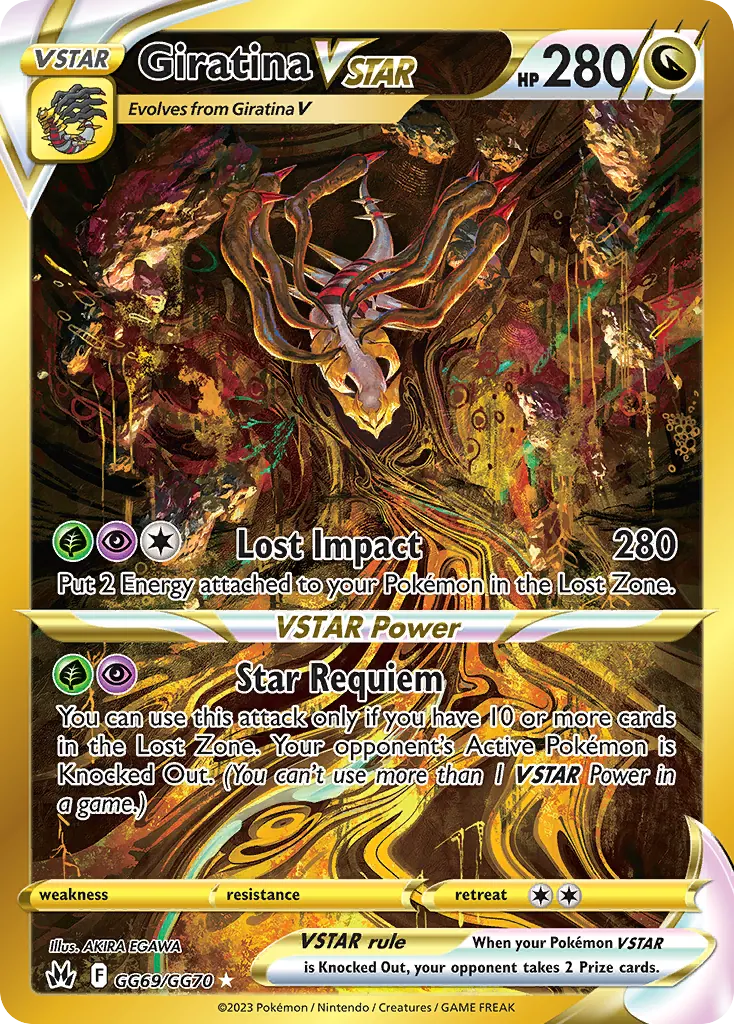
| Giratina VSTAR (Crown Zenith #GG69) | $332.37 | $320.45 | $650.00 | 40.0% |
| Umbreon VMAX (Evolving Skies #215) | $2,250.00 | $2,118.50 | $4,357.94 | 22.7% |
| Mega Greninja ex (Chaos Rising #116) | $226.89 | $259.43 | $693.60 | 20.6% |
| Ash-Greninja-EX (XY Promos #XY133) | $111.84 | $999.29 | $9,944.92 | negative |
| Charizard (Base Set Unlimited #4) | $372.39 | $2,675.00 | $29,090.72 | negative |
A negative break-even gem rate is not a rounding artifact. It means that even if you never hit a single 10, the PSA 9 by itself returns more than your all-in cost, so grading beats buying the slab regardless of how the coin lands.
The PSA 9 decides this, not the PSA 10
Look at the table again and notice what does not predict the answer. Zoroark has a 2.9x PSA 10 multiple and is the worst submission on the list. Umbreon has a 1.9x multiple and is one of the best. Base Set Charizard has a 78x multiple and Ash-Greninja has an 89x multiple, and they land in the same place as Umbreon's 1.9x.
The multiple tells you almost nothing, which is the same conclusion we reached from a different direction in why a huge PSA 10 multiplier is usually a trap. What actually drives every row is where the PSA 9 sits relative to what you paid plus the fee.
There are three regimes, and you can sort any card into one in about ten seconds:
PSA 9 well below raw plus fee. Every dollar rides on hitting the 10. Zoroark's 9 sells for $48 against a $50.52 raw copy and a $95 fee, so a miss is a $100 hole you have to dig out of on the next attempt. This is the PSA 9 tax at its most punishing.
PSA 9 roughly equal to raw plus fee. A miss costs you the fee and nothing more. Your gem rate needs to be genuinely good, somewhere in the 40% range on the two Crown Zenith alt arts above, and Galarian Gallery cards are notorious enough for centering drift that most people will not clear that bar honestly.
PSA 9 well above raw plus fee. Grading is close to a free roll. Mega Greninja's 9 sells for $259.43 against a $226.89 raw copy, so a miss still clears the fee. Ash-Greninja's 9 sells for nine times an all-in submission. You do not need the 10 to win, which means you should stop underwriting the trade to the 10 at all.
What the fee change actually broke
Here is the same set of cards run at the old $40 all-in Value cost against the current $95:
| Card | Break-even at $40 all-in | Break-even at $95 all-in |
|---|---|---|
| N's Zoroark ex | 46.5% | 99.0% |
| Darkrai VSTAR #GG50 | 22.4% | 49.2% |
| Giratina VSTAR #GG69 | 25.2% | 40.0% |
| Mega Greninja ex | 8.8% | 20.6% |
The cards at the bottom barely moved. The cards at the top moved enormously. That is not a coincidence: a flat fee increase is regressive, and it lands hardest on exactly the cards where the PSA 9 was already failing to cover the miss.
The practical consequence is that the entire band of $40 to $120 modern chase cards, which was the bread and butter of casual submissions all through 2025, has quietly stopped working. If your grading queue is full of $50 SIRs you picked because the PSA 10 comp looked like triple the raw, that queue was built for a $25 fee that no longer exists. And the 40 to 50 business day turnaround on Regular stacks a second problem on top, because your card keeps moving while you wait for the slab.
Where we got this badly wrong
On June 4 we looked at Ash-Greninja-EX #XY133 during its nostalgia run and advised caution: do not buy raw around $80 to chase the slab, and grade only a flawless copy you already owned. The PSA 10 was $2,143.27 at the time.
Today that PSA 10 reads $9,944.92 and the PSA 9 reads $999.29. TCGPlayer's near-mint market price went from $84.39 to $111.84, up 32.5%. The caution was wrong in both legs.
The reason we got it wrong is worth more than the miss. We had just watched a Pikachu & Zekrom GX spike round-trip completely after a reprint announcement, and we pattern-matched Ash-Greninja to it. But those two spikes had opposite plumbing. A reprint reveal creates future supply, which is the mechanism that unwinds the move. A 2016 promo that will never be printed again has no such mechanism, so attention just compounds against fixed supply. The question to ask on any nostalgia spike is not "how emotional is this catalyst" but "does this catalyst create supply."
One caveat we will not paper over: that $9,944.92 PSA 10 sits on a thin population, and thin comps revert. The reliable part of the Ash-Greninja ladder is the $999.29 nine, and that alone is enough to justify submitting. The harder problem is sourcing. PriceCharting's blended ungraded figure for this card is $27.46 against a $111.84 near-mint market, and that four-fold spread is not staleness, it is condition. Most surviving copies are played 2016 promos that will never grade, which is the difference between a real gap and an arbitrage illusion. Base Set Charizard carries the same trap: its $372.39 blended raw price is an average that includes badly beaten copies, and a genuinely clean Unlimited copy costs several times that.
What to do this week
Pull up the PSA 9 price on every card sitting in your grading pile, then compare it to what you paid plus $95. That single comparison sorts the pile faster than any gem-rate guesswork, and it will probably empty half of it.
For whatever survives, then estimate your gem rate honestly using the pre-grade checks, and only submit where your real number beats the break-even. Flipr's profit calculator carries the current $79.99 tier and the PSA 9 outcome rather than only the 10, which is the difference between a submission that looks good and one that is good.
The uncomfortable summary is that on most modern cards under about $150 raw, the honest answer is now to buy the slab and skip the submission entirely. That was not true in May. Fee schedules are not background noise, and this one moved the line under a lot of people's inventory.
Want to flip smarter, not harder?
Flipr's free toolkit surfaces the most profitable cards to grade and the spreads to arbitrage, refreshed every 30 minutes. Twelve tools, zero subscriptions.
Open FliprMore on PSA flipping
PSA 10 Pokemon Card Prices Are Dropping Faster Than Raw Cards
We re-checked eight cards we covered since May. Raw prices fell about 14%, PSA 10 prices fell about 19%, and the reward for grading shrank on six of the eight.
Most PSA 9 Pokemon Cards Are Not Worth Cracking
Live PriceCharting grids and PSA's own fee page show what cracking a PSA 9 and resubmitting costs in 2026. The $1,500 insured value cap is the catch.
PSA's Upcharge Rule Can Add $500 to Your Grading Bill
A PSA upcharge is priced off what your card is worth after grading, not what you paid for it. We ran seven live grade grids to see which cards trip the rule.