
Stop Counting Profit Per Card. Count Profit Per Day.
Two flips with the same gross profit can return wildly different amounts. Why annualized ROI, not profit per card, is the only flipping metric that matters.
Two flippers close out the month and compare notes. Both cleared about five hundred dollars on a single card, so they high-five. One of them just had a genuinely great month. The other tied up most of his bankroll for seven weeks to earn what the first guy earns on pocket change. They are not in the same business, and the profit number alone will never tell them apart.
That is the problem with how most people grade their own flipping. We brag about the slab that netted $1,800 and quietly forget it ate $2,000 of capital for two months. We treat a $500 profit as a $500 profit no matter what it cost to produce. The market does not reward gross profit. It rewards how fast and how hard your money works, and those are not the same thing.
The number that actually compounds
The metric that matters is return on capital per unit of time. You can write it as one line:
annualized ROI = (profit ÷ capital) × (365 ÷ days the money was tied up)
Profit per card is a vanity number because it ignores both terms in that equation. A flip that returns 40% of your capital in three weeks is destroying a flip that returns 90% over four months, even though the second one has the bigger dollar figure stapled to it. Your bankroll does not care what one card made. It cares how many times per year you can recycle the same dollars at a healthy margin.
Once you start thinking in profit per dollar per day, a lot of "obvious" plays flip upside down.
A $117 card that out-earns a $2,000 one
Here are two real cards, both priced live on PriceCharting on June 8, 2026, run through the same PSA 10 flip.
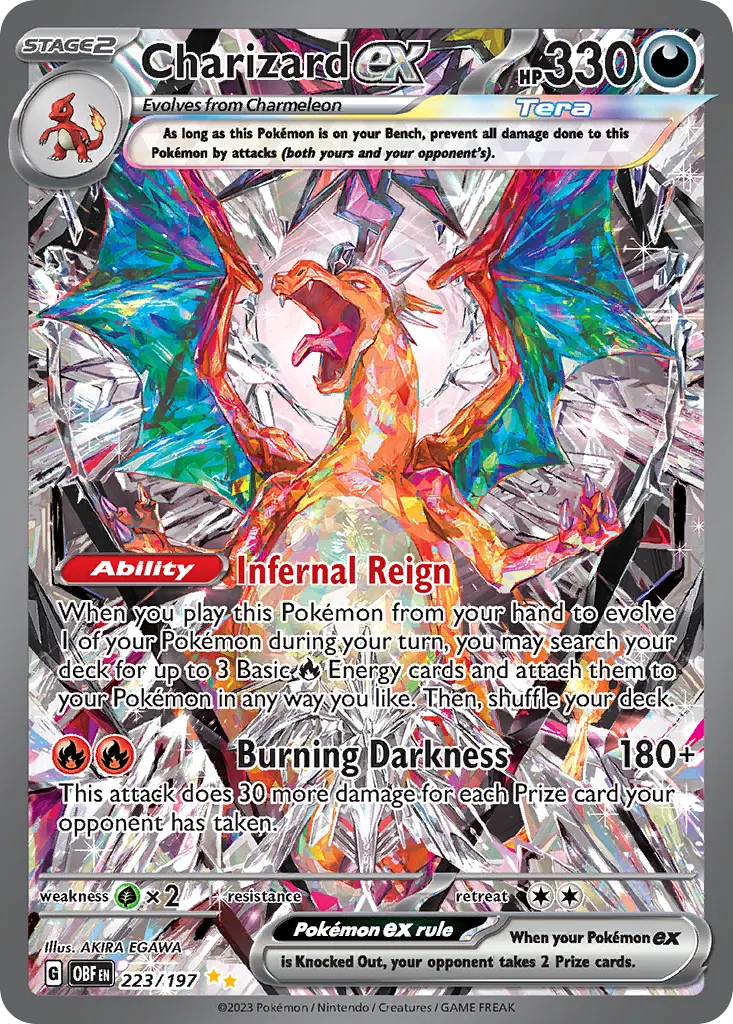
The cheap one is Charizard ex #223 from Obsidian Flames. Raw near-mint sits at $117.40, the PSA 10 at $775.00. The expensive one is the Umbreon VMAX #215 alt art from Evolving Skies, the Moonbreon everyone knows: raw $2,048.42, PSA 10 $4,500.00. Use a flat $25 grading fee and eBay's 12.35% take on the sale for both.
| Charizard ex 223 | Umbreon VMAX 215 | |
|---|---|---|
| Raw buy + $25 grade | $142.40 | $2,073.42 |
| PSA 10 sale | $775.00 | $4,500.00 |
| Net after 12.35% fee | $679.29 | $3,944.25 |
| Profit (PSA 10) | ~$537 | ~$1,871 |
| ROI on capital | 377% | 90% |
| Approx. cycle | ~52 days | ~52 days |
The Umbreon makes three and a half times the gross profit. It is also, measured honestly, the far worse flip. Same roughly seven-week cycle (PSA Standard runs about 45 calendar days in practice, plus a week to sell), but the Charizard returns 377% on the capital it locks up while the Moonbreon returns 90%. If you can keep that cheap slot filled, $142 turns roughly seven times a year. The $2,073 sits there doing one lap.
Why the bigger gross profit is the worse flip
Seven cycles at 377% is not literally seven times the profit in the real world. You cannot always re-source a chase card the day it sells, supply on the good ones is thin, and not every submission comes back a 10. But directionally the point holds: the small fast card is working far harder per dollar than the trophy slab, and the gap compounds over a year.
The downside math makes it worse for the expensive card. A flip is only as good as its miss case, and on high-end modern the miss is brutal. Land a PSA 9 on that Umbreon and it sells for $2,250, which nets $1,972 after fees against the $2,073 you put in. That is a roughly $100 loss for tying up two thousand dollars for seven weeks. This is the same trap we covered in the PSA 9 tax: on thin-spread cards a 9 is a wash or a loss, and all your profit lives inside the 10. Miss the Charizard's 10 and you sell the PSA 9 at $158.57, netting $139 against $142. You are out about three dollars. One miss costs you a coffee. The other costs you a hundred bucks and seven weeks of dead capital.
So the cheap card wins on the upside (higher ROI), wins on the downside (a near-harmless miss), and wins on velocity (you can run more of them in parallel). The only thing the expensive card wins is the number you get to brag about.
The trophy-card exception
There is one honest counterargument, and it is the Base Set Charizard sitting in everyone's head. On the same June 8 pull, raw is $338.42, the PSA 9 is $3,175.04, and the PSA 10 is a frankly silly $30,085.73. The vintage Charizard does not play the velocity game at all, and that is the point: it is a store of value, not active flipping capital. You hold it because it appreciates and almost never grades into a loss, not because you are turning it seven times a year.
That is a legitimate strategy. Just do not confuse it with flipping. Money parked in a trophy card is doing a different job (slow appreciation, low risk) than money working a flip rotation (fast turns, higher ROI, higher effort). Problems start when a flipper mentally counts a long-term hold as part of their working bankroll and wonders why their cash never seems free to chase the next opportunity. It is not free. It is in a slab on a shelf.
The three levers you actually control
If profit per day is the target, three things move it, and you control all three.
Hold time. Every day at the grader is a day your money earns zero. The fastest honest lever is the service tier you pick, and the real calendar medians (not the stated business days) are what matter for the math. We broke those down in the PSA, CGC, and BGS turnaround comparison. The other half is days-to-cash on the sell side, which is why picking the marketplace that moves fastest, not the one with the lowest headline fee, matters more than most flippers think.
Capital per slot. Smaller cards mean more flips running at once for the same bankroll. Ten $150 cards in the queue beat one $1,500 card if the ROI per card is comparable, because a bad grade on any single one barely dents you and the wins stack.
Hit rate. A miss does not just lower your average, it resets the clock. You waited 52 days to find out, and now that capital starts over. That is why reading the card under a flashlight before you ship it is a velocity tool, not just a quality one. Every avoided miss is seven weeks you did not waste.
What this changes about what you buy
For most flippers running under a serious bankroll, the lesson is uncomfortable: the cards that feel impressive to own are usually the wrong inventory. A rotation of $80 to $150 fast movers with strong PSA 10 spreads will out-earn one prestige slab almost every time, and it will do it with less downside on any single miss. The trophy cards are fun, and they have their place as long-term holds. They are not where a working bankroll wants to live.
Run the per-day number before you buy, not after you sell. Flipr tracks cost basis, grading fee, and the date you submitted on every card, so the profit it shows you is net of fees and tied to how long the capital was actually out. That turns "I made $1,871" into "I made $1,871 over 54 days on $2,073," which is the version of the sentence that tells you whether to do it again.
Bottom line
Gross profit per card is the easiest number to track and the easiest one to fool yourself with. The flip that made the most money this month was very possibly your worst use of capital. Start measuring profit per dollar per day, treat hold time as a cost, and judge every card against how fast it frees your money to go again. The flippers who quietly compound are not the ones landing the biggest single hits. They are the ones whose money never sits still.
Want to flip smarter, not harder?
Flipr's free toolkit surfaces the most profitable cards to grade and the spreads to arbitrage, refreshed every 30 minutes. Twelve tools, zero subscriptions.
Open FliprMore on PSA flipping
Why a Huge PSA 10 Multiplier Is Usually a Trap
An $18 card with a $900 PSA 10 looks like free money. We pulled the full grade ladders. The size of that multiple is a warning about your odds, not an invitation.
PSA 10 Pokemon Card Prices Are Dropping Faster Than Raw Cards
We re-checked eight cards we covered since May. Raw prices fell about 14%, PSA 10 prices fell about 19%, and the reward for grading shrank on six of the eight.
Buy the PSA 10 or Grade Your Own? The $79.99 Math
PSA paused its Value tiers, so grading now starts at $79.99. We ran the break-even gem rate on seven live price grids to find when buying the slab wins.